Crete
In my later years of college I began reading Nikos Kazantzakis. I had seen the movie “Zorba the Greek” and was profoundly influenced by his other written works, especially his autobiography “Report to Greco.” Less an outline of his life and more an accounting of his spiritual journey and growth, the book set me on fire. He wrote passionately about the connection of spirit and physicality. It spoke to me.
Some fifty years later I finally journeyed to Crete, Kazantzakis’s birthplace. During an evening walk, Peggy and I came upon his grave. Out of all the resting places of influential human beings, this one had a personal significance for me. His epitaph: “I hope for nothing. I fear nothing. I am free.”
We traveled to Crete for both cultural exploration and physical adventuring. The two complemented each other well, and even felt appropriate relative to Kazantzakis’s focus on the fusion of spirit and flesh. The first week we explored western Crete, driving and hiking through the rough countryside. The Samaria Gorge, the second longest gorge in Europe, was a spectacular walk descending 1250 meters over 16 km and ending up at the small roadless coastal village of Agia Roumeli where we took a ferry to a nearby town, transferred to a bus, and were transported back to our starting point. A couple of days later we undertook a second long hike along the coastal E4 footpath. The trail passed by the ancient site of Lissos, a settlement dating back at least to 300 BCE. Many ruins remain from this once important trading and fishing port, all nestled in a tight valley leading down to a small sheltered cove. From there the E4, a long trail traversing a number of European countries, wandered along the coast towards Paleochora affording splendid views of the Libyan sea.
After further exploration of western Crete, we drove to the eastern end of the island and joined a group of cyclists from People’s Cycling. We biked through the interior and along the southern coast before returning to the northern part of the island, stopping at various cultural and historical sites. The former included a working farm, a monastery, and an olive oil processing facility. The latter included the leper colony of Spinalonga, the Minoan palace at Knossos, and the fortified Venetian turned Ottoman towns of Chania and Rethymnon as well as various ancient ruins scattered through the countryside.
Crete’s landscape was mountainous and rugged. The soil seemed dry and lacking significant topsoil layer; trees, brush, and scrub dominated in place of fertile forests and fields. Conditions did favor olive trees, which covered ¼ of the surface of the island and supported a thriving olive oil business, and the harvest was soon to begin. Vineyards were also evident, though the grape harvest was already completed. The harshness of the landscape lent the impression of constant struggle for survival on the part of the many living things that made their home on Crete.
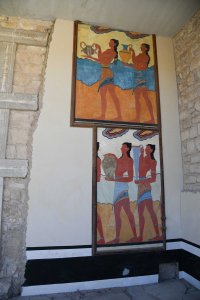
This struggle was also evident in Crete’s history. Stone-age groups gave way to the Minoan civilization, one of the earliest in the western world. The Minoans were supplanted by the Mycenaeans, leading to the influence of Classical and Hellenistic Greece. Later came the Romans, the Byzantines, the Venetians, the Ottomans, and finally the Greeks again. In modern times, Crete became one of the most important theatres of WWII, with the Germans dislodging the Allies with much loss of life before eventually being defeated. Today, Crete is legally part of Greece but maintains a vibrant cultural identity of its own, with a very strong streak of independence.
The succession of ruling societies was frequently evident in physical historical sites. Spinalonga was originally a Venetian stronghold, then an Ottoman settlement before becoming a leper colony. The Minoan site of Knossos included ruins dating from the stone age through the Mycenaean period. In all of Crete’s main towns there is evidence of Roman rule, followed by Byzantine oversite, Venetian control, and Ottoman occupation. Each major power ousted its predecessor, sometimes politically, more often through force. But the pattern remained the same, one set of ruling class giving way to the next, all hungry for power, wealth, and strategic advantage.
This universal pattern was particularly evident in Crete, as its civilization’s history spans thousands of years. Such is the arrogance of humankind (particularly men). It brought to mind English poet Percy Shelley’s Ozymandias, written in 1818:
I met a traveller from an antique land,
Who said – “Two vast and trunkless legs of stone
Stand in the desert …. Near them, on the sand,
Half sunk a shattered visage lies, whose frown,
And wrinkled lip, and sneer of cold command,
Tell that its sculptor well those passions read
Which yet survive, stamped on these lifeless things,
The hand that mocked them, and the heart that fed;
And on the pedestal, these words appear:
My name is Ozymandias, King of Kings;
Look on my Works, ye Mighty, and despair!”
Nothing beside remains. Round the decay
Of that colossal Wreck, boundless and bare
The lone and level sands stretch far away.
Shelley’s irony illuminates this human folly: those desiring to exercise control may wield immense power and see themselves as grandiose figures, but over the years all yield to the slow erosion of time until some new aspiring ruler comes to usurp the old.
Still, despite history’s foibles writ evident everywhere in Crete, so is the strong will to be free, to live close to the elements and the natural world, to maintain strong family ties, to welcome travelers with warm hospitality, and to pass down traditions of the heart. All of these positive qualities overshadow the cyclical struggles for power, and offer us all hope.
I highly recommend a visit!
Scott McGovern
 Through the Mind and the Eye
Leave a comment