To Serve, To Strive, and Not to Yield
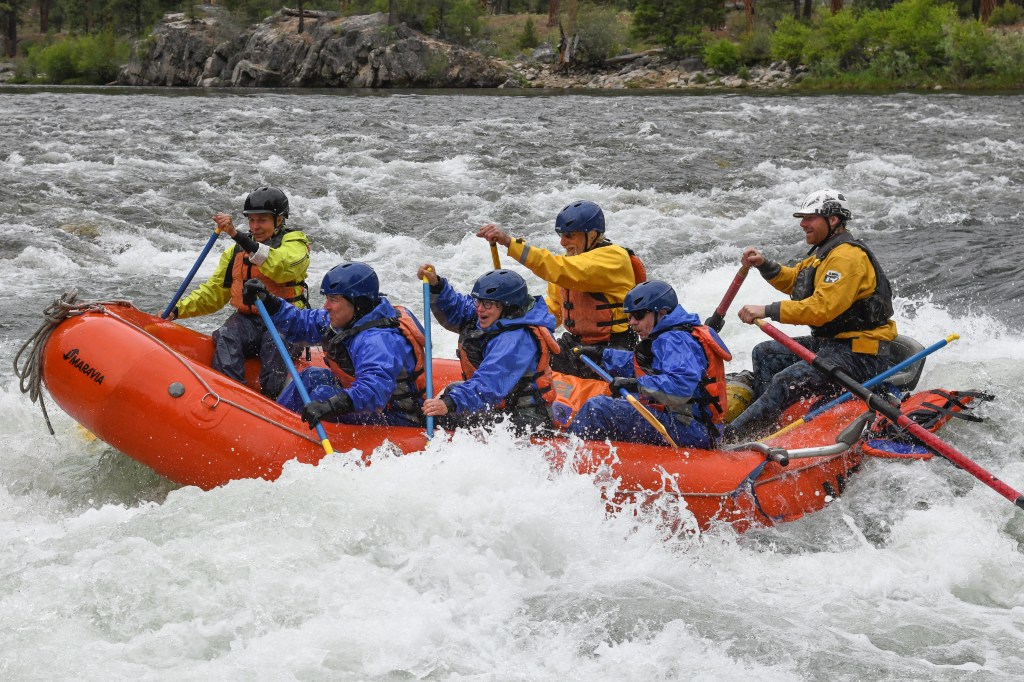
 This past June Peggy and I joined a group of former staff connected with the North Carolina Outward Bound School (NCOBS) and the Nantahala Outdoor Center (NOC) for a rafting trip down the Middle Fork of the Salmon River in Idaho. The Middle Fork is reputed to be one of the most exciting and beautiful whitewater runs in the world, dropping an extraordinary 4000 feet over 104 miles and carving out a channel that is deeper than the Grand Canyon in places. There are over 100 rapids, many rated Class III – IV, and the paddling draws 10,000 visitors each year on a mixture of commercial and private trips. The river corridor goes through the Frank Church – River of No Return Wilderness and is within the largest contiguous area in the lower 48 states without roads.
Hoping to secure a private permit for this river (which are notoriously difficult to obtain), five or six of us applied through the US Forest Service lottery with no success. Realizing that the number of years we have left to do trips like these are dwindling, we chose to join a commercial trip run by Middle Fork River Expeditions out of Stanley, Idaho. Twelve of us with varied connections to each other through NCOBS and NOC joined 11 other guests and seven guides for a six-day paddle. Our Outward Bound group averaged well over 70 years in age, the youngest member of the entire client group was 48, and the rest of the clients appeared to be in their 50’s or early 60’s.
The whitewater, scenery, and catering exceeded my expectations. The rapids were exciting and continuous in most places; there were few stretches of flatwater of any significant length. Steep hillsides rose abruptly from the river’s edge offering dramatic views throughout the length of the Middle Fork. The food and service were excellent, and the guides were very competent, personable, and worked hard to ensure we had a positive experience. (Ironically, one of the few sources of mild discomfort was the degree to which we were waited upon. Our offers to help were almost always politely refused, and particularly for those of us used to being in the role of instructor this was an offsetting experience.)
The trip was not without significant challenges, however. The first three days were very cold and rainy (it even snowed), and these conditions combined with continuous wave splash from large rapids to make for some very uncomfortable time in the boats. The guides did their best to provide warmth through fires at lunch and dinner, and in some cases loaning guests some of their personal clothes. The most reliable source of heat was produced through running around and moving. In the boats, this was an issue for those of us in the oar rigs, where our role was to sit tight and hold on. Those in the inflatable kayaks (duckies) and the paddle raft at least could move a bit when paddling but were also exposed to more splash in their boats.
Group members faced their own personal challenges as well. Participants were dealing with serious health issues: metastatic breast cancer, double knee replacements, loss of hearing, back issues, cognitive decline, and other infirmities associated with aging. Additionally, some guests were dealing with various life traumas, most notably the loss of a partner in one case, and the loss of a child in another. From a Buddhist perspective, the group as a whole had its fair share of suffering.
Yet there was little complaint. I found it extraordinary that a group of 30 individuals who did not all know each other kept such positive attitudes throughout these conditions. The group got along amazingly well, and I suspect this helped buoy spirits. Although there were plenty of remarks about the poor conditions, there was little actual griping. People were polite and supportive of one another even in the most stressful of situations. There was not one person in the entire group I would not have enjoyed sitting and conversing with.
On the last night of our time together I was moved to share a few words about the overall experience and how it brought me back to my roots in Outward Bound. The motto of OB is: “To Serve, To Strive, and Not to Yield.” This is taken from Tennyson’s poem “Ulysses”, where the author imagines the most famous of Greek heroes, Odysseus, discontent to relax in old age and calling upon his comrades to join him once again in new adventures, perhaps not as dramatic as they once managed, but still engaging life as fully as possible. (Note: Ulysses is the Latin name for Odysseus.)
Ulysses
By Alfred, Lord Tennyson
It little profits that an idle king, By this still hearth, among these barren crags, Match’d with an aged wife, I mete and dole Unequal laws unto a savage race, That hoard, and sleep, and feed, and know not me. I cannot rest from travel: I will drink Life to the lees: All times I have enjoy’d Greatly, have suffer’d greatly, both with those That loved me, and alone, on shore, and when Thro’ scudding drifts the rainy Hyades Vext the dim sea: I am become a name; For always roaming with a hungry heart Much have I seen and known; cities of men And manners, climates, councils, governments, Myself not least, but honour’d of them all; And drunk delight of battle with my peers, Far on the ringing plains of windy Troy. I am a part of all that I have met; Yet all experience is an arch wherethro’ Gleams that untravell’d world whose margin fades For ever and forever when I move. How dull it is to pause, to make an end, To rust unburnish’d, not to shine in use! As tho’ to breathe were life! Life piled on life Were all too little, and of one to me Little remains: but every hour is saved From that eternal silence, something more, A bringer of new things; and vile it were For some three suns to store and hoard myself, And this gray spirit yearning in desire To follow knowledge like a sinking star, Beyond the utmost bound of human thought.
This is my son, mine own Telemachus, To whom I leave the sceptre and the isle,— Well-loved of me, discerning to fulfil This labour, by slow prudence to make mild A rugged people, and thro’ soft degrees Subdue them to the useful and the good. Most blameless is he, centred in the sphere Of common duties, decent not to fail In offices of tenderness, and pay Meet adoration to my household gods, When I am gone. He works his work, I mine.
There lies the port; the vessel puffs her sail: There gloom the dark, broad seas. My mariners, Souls that have toil’d, and wrought, and thought with me— That ever with a frolic welcome took The thunder and the sunshine, and opposed Free hearts, free foreheads—you and I are old; Old age hath yet his honour and his toil; Death closes all: but something ere the end, Some work of noble note, may yet be done, Not unbecoming men that strove with Gods. The lights begin to twinkle from the rocks: The long day wanes: the slow moon climbs: the deep Moans round with many voices. Come, my friends, ‘T is not too late to seek a newer world. Push off, and sitting well in order smite The sounding furrows; for my purpose holds To sail beyond the sunset, and the baths Of all the western stars, until I die. It may be that the gulfs will wash us down: It may be we shall touch the Happy Isles, And see the great Achilles, whom we knew. Tho’ much is taken, much abides; and tho’ We are not now that strength which in old days Moved earth and heaven, that which we are, we are; One equal temper of heroic hearts, Made weak by time and fate, but strong in will To strive, to seek, to find, and not to yield.
I think about my companions on this river journey and reflect on the physical and emotional pain and other limitations that all of us are facing and dealing with to some degree as we age. And yet here we are, embracing adventure as best as we are able even as our decline impacts the amount that we are able to accomplish. And in embracing adventure, what we are really doing is embracing life itself; living life as fully as possible. I am aware there is some risk we take in doing so. In challenging oneself to go beyond perceived limits there is always the possibility that failure can be accompanied by significant consequence, especially in advanced age. But I believe that the very act of taking such risks, of continuing to push and extend oneself, on the balance serves to keep enhancing our health and in the long run, prolongs quality of life in all of its dimensions: physical, mental, emotional, and spiritual.
When I was a youthful instructor I tended to narrowly regard the teachings of Outward Bound — of overcoming self-limiting perceptions and realizing that we are capable of much more than we think — as applying primarily to challenges one faces in the prime of life. I was aware that these challenges could be non-physical, and that the physical hardships intentionally built into an Outward Bound course served as metaphors for all types of challenges. But I never reflected on its power in helping to face that inevitable, monumental challenge we all face, our decline and eventual death. This is possibly the greatest task we must all undertake. Now that I find myself transitioning into this stage of life, however, I am grateful to have been taught this mindset and I am especially grateful to see it so dramatically embodied in my companions on this river trip. It is truly inspirational.
Scott McGovern
 Through the Mind and the Eye
Leave a comment